
When it comes to municipal infrastructure—manhole covers, drainage gratings, trench systems, and utility access components—the choice of material directly impacts durability, safety, and lifecycle cost. Two commonly used materials in foundry casting are ductile iron and gray cast iron. While both have their place, selecting the right one depends on application, load conditions, and long-term performance expectations.
At Ultra Tech Foundry (UTF), we manufacture both materials with precision and compliance, helping infrastructure planners make informed decisions aligned with performance and standards.
Understanding the Materials
1. Ductile Iron
Ductile iron is engineered by adding magnesium to molten iron, which changes the graphite structure into spherical nodules. This transformation significantly improves strength and flexibility.
Key Properties:
- High tensile strength and impact resistance
- Excellent ductility (can deform without breaking)
- Resistant to heavy loads and dynamic traffic stress
- Longer service life under harsh conditions
Typical Applications:
- Manhole covers (EN124 C250, D400, E600, F900)
- Roadway and highway drainage systems
- Industrial and port infrastructure
2. Cast Iron
Gray cast iron contains flake graphite, which gives it good compressive strength but makes it more brittle compared to ductile iron.
Key Properties:
- Good compressive strength
- Cost-effective for low-load applications
- Lower resistance to impact and shock
- Prone to cracking under heavy or dynamic loads
Typical Applications:
- Light-duty covers (A15, B125)
- Pedestrian zones, gardens, sidewalks
- Non-critical drainage systems
Head-to-Head Comparison
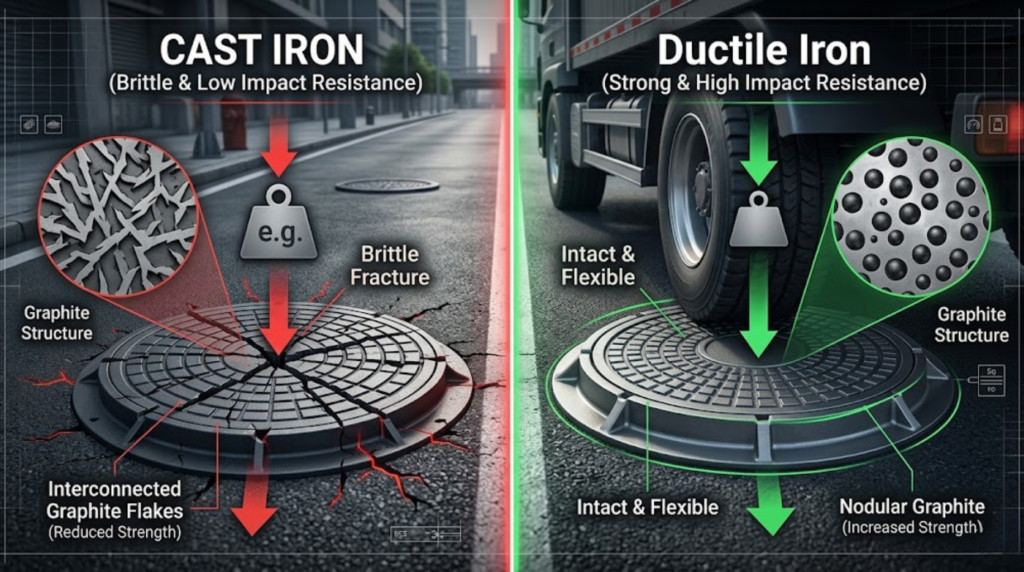
| Feature | Ductile Iron | Cast Iron |
|---|---|---|
| Strength | Very High | Moderate |
| Impact Resistance | Excellent | Low |
| Flexibility | High (ductile) | Brittle |
| Load Classes | Up to F900 | Typically up to B125/C250 |
| Crack Resistance | High | Low |
| Lifespan | Longer | Shorter |
| Cost | Higher initial cost | Lower initial cost |
| Maintenance | Minimal | More frequent replacement |
Which is Better for Municipal Infrastructure?
Choose Ductile Iron When:
- The installation is in roads, highways, or heavy traffic zones
- Safety and long-term durability are critical
- You need compliance with EN124 D400 or higher load classes
- Lifecycle cost matters more than initial cost
Choose Cast Iron When:
- The application is light-duty (pedestrian or landscaped areas)
- Budget constraints are strict
- Load exposure is minimal and predictable
The UTF Recommendation
For modern municipal infrastructure, ductile iron is the preferred choice due to its superior mechanical properties, safety margin, and long-term performance. While cast iron may reduce upfront costs, it often leads to higher maintenance and replacement expenses over time.
At Ultra Tech Foundry, we align our production with global standards and engineering best practices:
- EN124-compliant ductile iron covers and frames
- Precision casting with consistent load-bearing performance
- Export-ready packaging and quality assurance
- Custom sizes ranging from 300×300 mm to 1200×1200 mm
Final Thoughts
Infrastructure is a long-term investment. Choosing the right material is not just about cost—it’s about safety, reliability, and performance over decades.
Ductile iron stands out as the smarter, future-ready solution for municipal applications, especially where load, impact, and environmental stress are significant.
If you are planning a project and need help selecting the right casting specifications, feel free to share:
- Load class requirement
- Dimensions
- Application area
- Quantity
We’ll help you identify the most suitable solution—engineered with experience and science.